Let’s be honest for a second.
Most startup founders are obsessed with time.
Calendars full. Back-to-back meetings. Deadlines everywhere.
But here’s the real question:
Are you actually productive… or just busy?
Because success in business doesn’t come from managing time well.
It comes from managing energy well.
Let’s break this down in a simple way.
The Biggest Myth: “I Don’t Have Time”
You’ve probably said this before:
- “I don’t have time to exercise”
- “I don’t have time to think”
- “I don’t have time to plan”
But the truth is…
You had the time. You didn’t have the energy.
Think about it:
After a long, stressful day, do you feel like making good decisions?
Do you feel creative? Focused? Strategic?
No.
Because time was there.
Energy was not.
Time Management vs Energy Management
Let’s compare both clearly.
Time Management
- Focus on hours and schedules
- More tasks = more productivity (wrong assumption)
- Leads to burnout if overused
Energy Management
- Focus on physical, mental, emotional state
- Better energy = better output in less time
- Leads to clarity, creativity, and smarter decisions
Here’s the difference in one line:
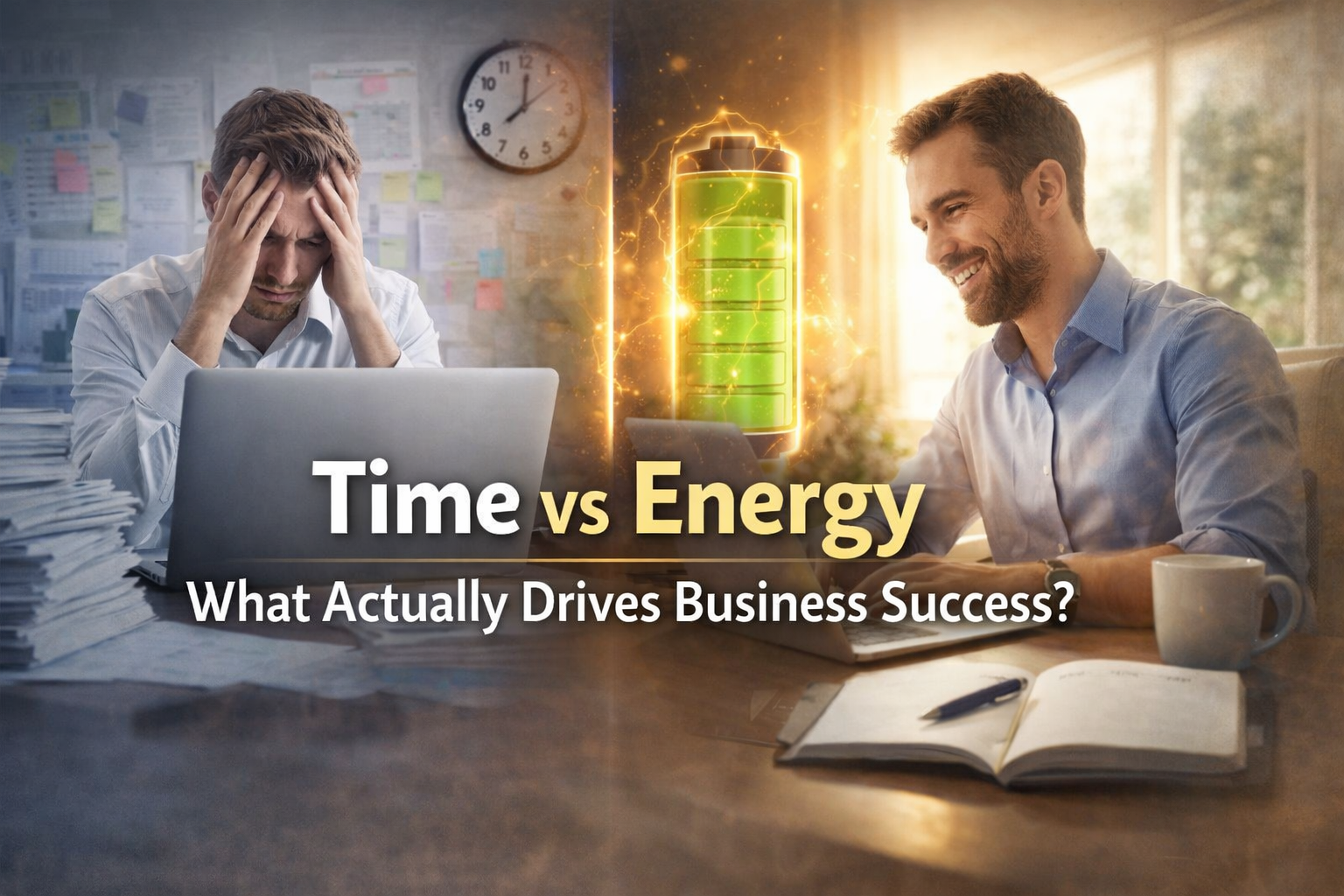
Time decides how long you work. Energy decides how well you work.
Why Energy Wins in Business
As a founder, your real job is not doing more work.
Your real job is making better decisions.
And decisions don’t come from tired minds.
When your energy is high:
- You think clearly
- You solve problems faster
- You communicate better
- You lead with confidence
When your energy is low:
- You delay decisions
- You overthink
- You react emotionally
- You avoid important work
Same 24 hours.
Completely different results.
The Hidden Cost of Low Energy
Low energy doesn’t just affect you.
It affects your entire business.
- Your team feels your mood
- Your communication becomes unclear
- Your vision becomes weak
- Your execution slows down
You might still be working 10–12 hours a day…
But the impact becomes very low.
That’s dangerous.
High Performers Protect Energy, Not Time
Top performers don’t try to fill every hour.
They protect:
- Their sleep
- Their focus time
- Their mental clarity
- Their physical health
Because they understand one thing:
One hour of high-energy work can beat five hours of low-energy effort.
How to Start Managing Your Energy
Let’s keep it practical.
1. Fix Your Morning Energy
Don’t start your day with chaos.
Start with:
- Movement (walk, workout, stretch)
- Silence (no phone for first 20–30 mins)
- Clear intention for the day
This sets your baseline.
2. Work in Energy Peaks
Not all hours are equal.
Identify your best time:
- Morning deep work
- Afternoon meetings
- Evening planning
Do important work when your energy is highest.
3. Remove Energy Drainers
Some things silently kill your energy:
- Poor sleep
- Junk food
- Constant notifications
- Negative conversations
Fix these, and productivity automatically improves.
4. Take Strategic Breaks
Breaks are not laziness.
They are recovery tools.
Even 10–15 minutes of:
- Walking
- Breathing
- Disconnecting
Can reset your focus.
Final Thought
You don’t need more hours in the day.
You need better energy in the hours you already have.
Stop asking:
“How can I do more?”
Start asking:
“How can I show up better?”
Because in business,
it’s not about how long you work…
it’s about how powerful you are when you work. ⚡