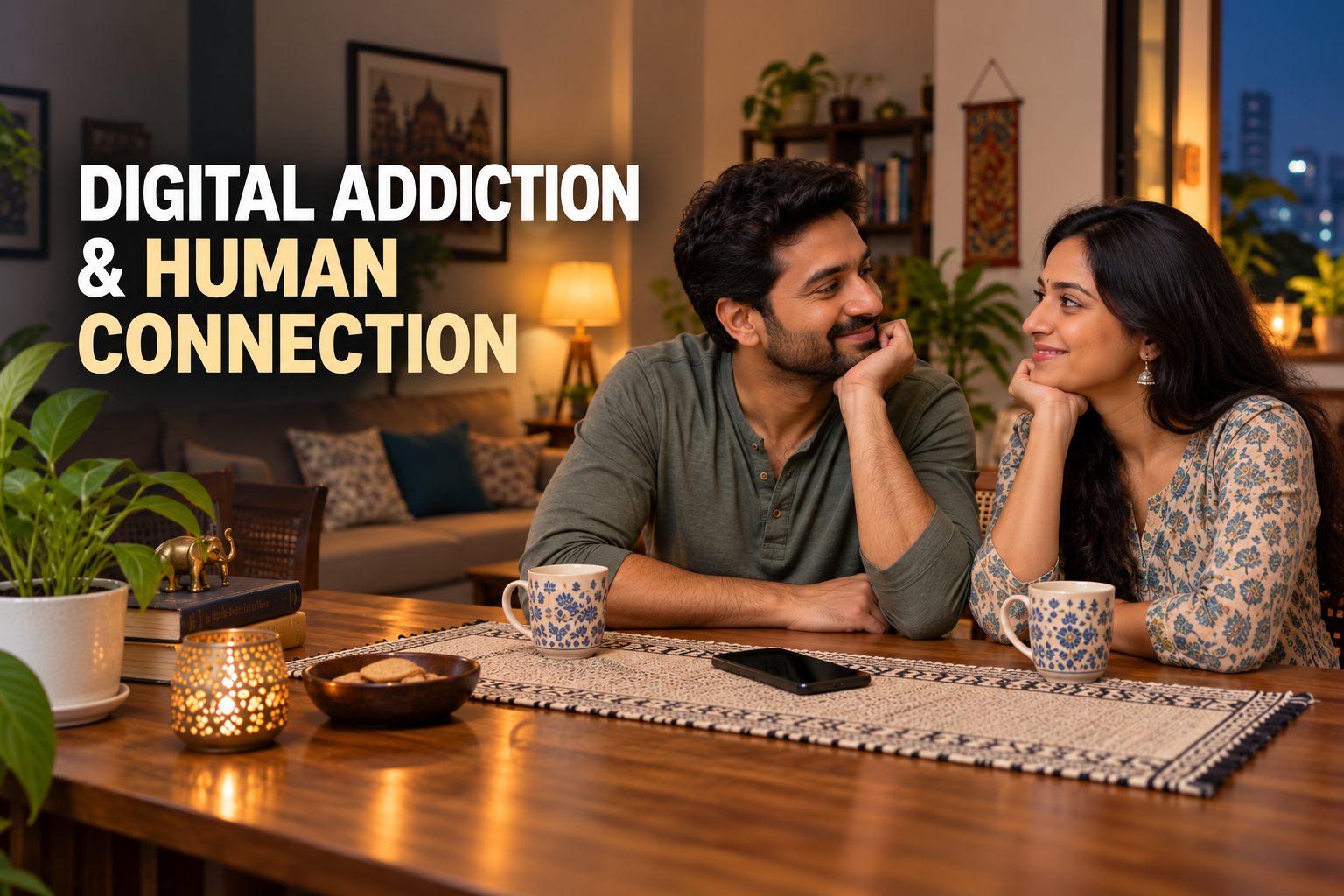
Digital addiction does not always look dramatic.
Sometimes it looks like checking your phone during dinner.
Sometimes it looks like scrolling while someone is talking.
Sometimes it looks like feeling anxious when there is no notification.
Sometimes it looks like being surrounded by people but still reaching for a screen.
In many Indian homes, this can happen even while families sit together after dinner, couples share the same sofa, or friends meet over chai. Everyone is close physically, but attention is still divided.
The slow loss of human connection often begins quietly. It does not happen in one big moment. It happens through small repeated choices where attention moves away from the person in front of us and toward the device in our hand.
Technology is not the enemy. It helps us work, learn, connect, create, and stay informed. But when digital use becomes compulsive, it can weaken the quality of our real relationships.
If you want to build more presence and emotional awareness in your relationships, the Coach For Life approach can help you reconnect with yourself and the people who matter.
Digital Addiction Is About More Than Screen Time
Digital addiction is not only about how many hours you spend online.
It is about your relationship with the screen.
Can you stop when you want to?
Can you be fully present without checking your phone?
Can you rest without needing stimulation?
Can you talk to someone without half-listening?
Can you sit with discomfort without escaping into scrolling?
These questions matter because the real issue is not technology itself. The real issue is loss of choice.
When digital use becomes automatic, attention stops feeling free.
Why Digital Addiction Feels So Normal
Digital addiction is easy to normalize because everyone is connected.
Phones are everywhere.
WhatsApp groups, reels, work updates, family messages, business calls, and constant notifications can make digital addiction feel like a normal part of Indian daily life.
Work messages arrive after hours.
Social media is designed to keep people scrolling.
Entertainment is available instantly.
Even silence can feel strange because the mind has become used to constant input.
As a result, many people do not notice the problem until their relationships begin to feel distant.
They may be physically present, but emotionally unavailable.
They may hear words, but miss feelings.
They may reply quickly online, but struggle to connect deeply offline.
This is how digital addiction slowly changes human connection.
Human Connection Needs Attention
Connection is not built only by being in the same room.
It is built through attention.
Eye contact.
Listening.
Warmth.
Patience.
Presence.
Emotional availability.
When attention is constantly interrupted, connection becomes shallow.
The person in front of you may begin to feel less important than the device beside you.
Even if you do not mean to hurt them, the message can still be felt:
"I am here, but not fully with you."
Over time, that feeling creates distance.
The Hidden Emotional Need Behind Scrolling
Many people use screens not only for entertainment, but also for emotional escape.
They scroll when they feel lonely.
They check messages when they feel uncertain.
They watch videos when they feel tired.
They stay busy online because stillness feels uncomfortable.
Digital addiction often grows when the screen becomes a quick way to avoid feelings.
The problem is that avoidance does not create peace. It only postpones what needs attention.
When you constantly escape into the digital world, your inner world remains unheard.
And when you are disconnected from yourself, it becomes harder to connect with others.
Relationships Suffer From Half-Presence
One of the biggest relationship costs of digital addiction is half-presence.
Half-presence means your body is there, but your attention is divided.
You are with your partner, but checking updates.
You are with your children, but thinking about messages.
You are with friends, but documenting the moment more than living it.
You are resting, but mentally pulled into online noise.
Human beings can sense divided attention. They may not always say it, but they feel it.
Over time, half-presence can become emotional loneliness.
People may start living together, eating together, and sitting beside each other, while still feeling unseen.
Digital Addiction Reduces Deep Conversation
Deep conversation requires time and emotional space.
It needs pauses.
It needs silence.
It needs curiosity.
It needs patience when the answer is not instant.
Digital addiction trains the mind to prefer speed. Quick replies. Short clips. Fast reactions. Constant novelty.
But relationships do not grow through speed alone.
They grow through depth.
If the mind becomes uncomfortable with slowness, deeper connection becomes harder.
This is why rebuilding human connection often requires rebuilding your tolerance for quiet, focused attention.
7 Warning Signs of Digital Addiction
Digital addiction can show up in simple everyday patterns.
Here are seven warning signs to notice:
- You check your phone without knowing why.
- You feel restless when your phone is not nearby.
- You scroll even when you are not enjoying it.
- You interrupt conversations to check notifications.
- You use screens to avoid difficult emotions.
- You feel disconnected from people even when you are together.
- You struggle to rest without digital stimulation.
These signs are not meant to create shame. They are meant to create awareness.
Awareness gives you back choice.
What Research Says About Healthy Technology Use
The American Psychological Association notes that technology and social media can bring benefits, but they can also create stress and interfere with in-person connection when use becomes constant. Their guidance on healthy technology use encourages people to unplug during time with friends and family.
This is important because human connection needs more than contact.
It needs quality attention.
Messaging someone is not the same as deeply listening to them.
Following someone’s updates is not the same as knowing their heart.
Being reachable is not the same as being emotionally available.
How to Rebuild Human Connection
The goal is not to reject technology.
The goal is to use it consciously.
Start with small boundaries.
Keep your phone away during meals.
Turn off non-essential notifications.
Create screen-free time before sleep.
Take short walks without your phone.
Listen to one person each day without multitasking.
Ask better questions in your relationships.
Let silence be part of your life again.
These small choices can rebuild presence.
And presence is the foundation of human connection.
Digital Discipline Is Emotional Discipline
Digital discipline is not only a productivity skill. It is an emotional skill.
It asks you to notice discomfort without immediately escaping.
It asks you to choose attention instead of impulse.
It asks you to protect the relationships that screens can quietly interrupt.
It asks you to be honest about what you are using technology for.
Are you using it to connect?
Or are you using it to avoid?
That question can change everything.
Final Thought
Digital addiction is not just about devices.
It is about attention.
It is about presence.
It is about the slow ways people drift from themselves and from each other.
The good news is that connection can be rebuilt.
Every time you put the phone down and look someone in the eyes, you return.
Every time you listen fully, you return.
Every time you choose presence over impulse, you return.
Technology can support life.
But it should not replace the human connection that makes life meaningful.