
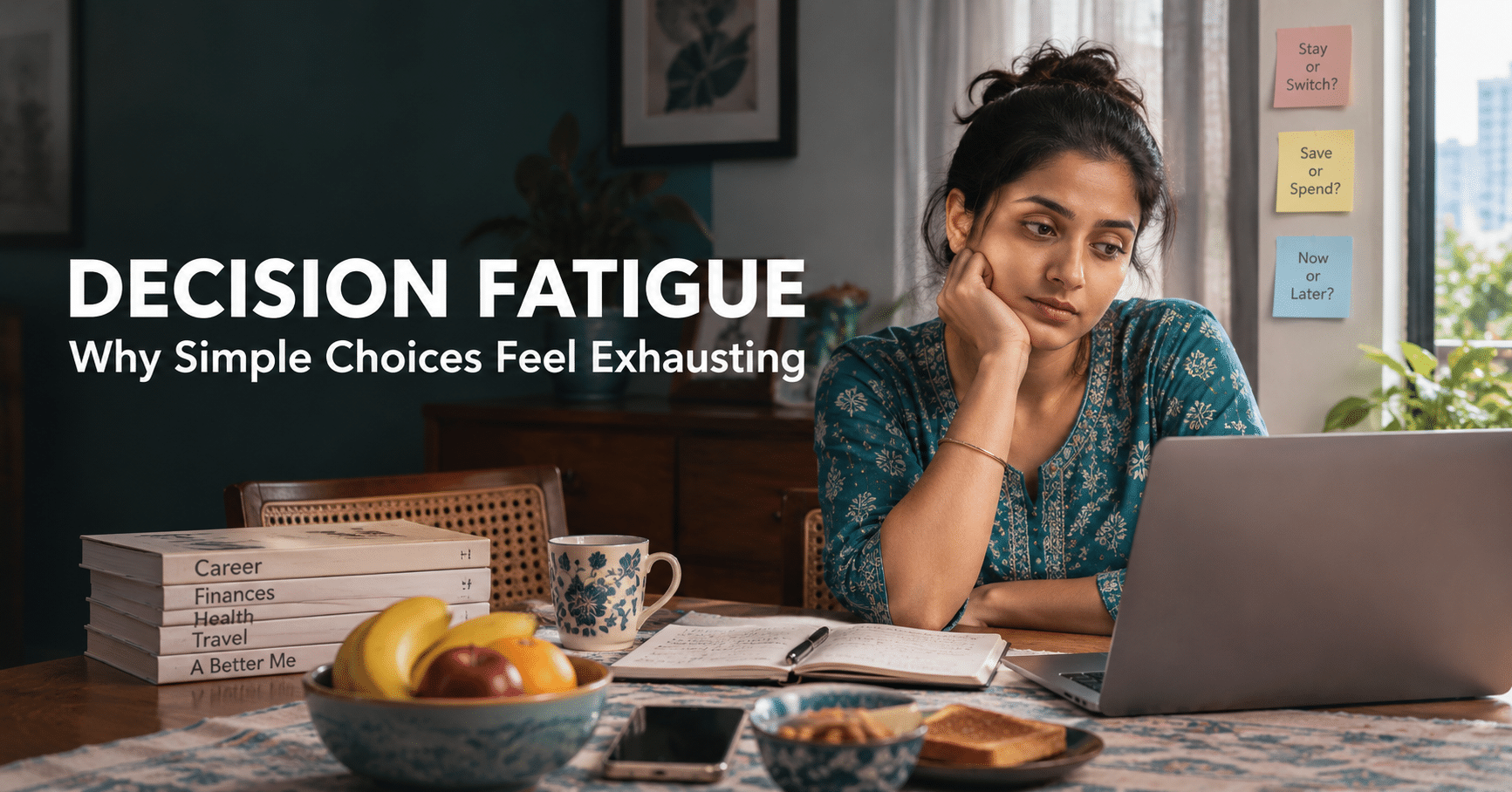
Decision fatigue can make an ordinary choice feel surprisingly exhausting. What should you wear? Which message should you answer first? Should you accept the invitation, order food, invest in an idea, or wait? None of these decisions seems enormous on its own, yet by evening even a simple question can feel like one demand too many.
This does not mean you are weak, lazy, or incapable. It often means your mind has been making choices all day without enough space to recover. In modern Indian life, the pressure can be especially layered. Work deadlines, family expectations, financial responsibilities, WhatsApp messages, health choices, social commitments, and constant online information all compete for attention.
The result is not always visible. You may still complete your tasks and look productive. Inside, however, your ability to think clearly may be slowly declining.
Understanding decision fatigue helps you protect your mental energy before important choices become impulsive, delayed, or emotionally driven.
What Is Decision Fatigue?
Decision fatigue is the mental strain that can build after making many decisions. As that strain grows, people may find it harder to compare options, control impulses, think patiently, or choose confidently.
The problem is not only the number of major decisions you make. Tiny decisions also consume attention:
- What should I reply?
- Which task should I begin?
- Should I check this notification?
- Is this purchase worth it?
- What should the family eat tonight?
- Should I say yes or disappoint someone?
When hundreds of these moments accumulate, the brain begins searching for the easiest escape. You may choose whatever feels quickest, postpone the decision, follow someone else’s preference, or keep researching without reaching an answer.
Decision fatigue is therefore not just tiredness. It is a reduction in the quality of attention available for choosing.
Why Simple Choices Start Feeling So Difficult
Important decisions naturally require thought. But when simple choices feel heavy, it is often because they arrive on top of unresolved mental load.
Imagine a business owner who has handled customer complaints, team questions, payments, targets, and supplier issues throughout the day. At home, someone asks, "Where should we go for dinner?" The question is easy, but the mind receiving it is already full.
The same thing happens to parents managing a home, professionals switching between meetings, students comparing career options, and caregivers thinking for several people at once.
The final choice is rarely the whole problem. It is simply the choice that arrives when very little mental energy remains.
7 Signs Decision Fatigue Is Affecting You
Decision fatigue can be easy to miss because it often looks like a personality problem. Notice whether these patterns appear more often after busy or emotionally demanding days:
- You postpone small decisions that would normally be easy.
- You keep comparing options but feel less certain with every comparison.
- You say yes simply because explaining no feels tiring.
- You make impulsive purchases, food choices, or online decisions late in the day.
- You ask other people to decide everything for you.
- You become irritated when someone asks a simple question.
- You avoid important conversations because you cannot process another choice.
These signs are not a reason for self-criticism. They are useful information. Your mind may be asking for fewer inputs, clearer priorities, and genuine recovery.
Too Many Options Can Reduce Clarity
We often assume that more choice creates more freedom. Sometimes it does. But unlimited options can also create pressure.
Streaming platforms offer endless entertainment. Online stores display thousands of products. Career advice arrives from dozens of creators. Every health goal comes with competing diets, routines, and opinions. Even a small purchase can become a research project.
When every option is treated as equally important, the mind has no clear filter. It continues comparing because it is afraid of making the wrong choice.
Clarity usually does not come from examining every possibility. It comes from knowing what matters most.
Your values act like a filter. When you know your priorities, many options can be dismissed without guilt.
Decision Fatigue and the Fear of Making a Mistake
Sometimes the exhaustion is not caused by choice alone. It is caused by the belief that every choice must be perfect.
Perfectionism turns ordinary decisions into tests of intelligence and self-worth. A person may think, "If I choose incorrectly, I will waste money, disappoint people, or prove that I am not capable."
This fear creates endless analysis. Instead of asking, "Is this choice good enough for the information I have?" the mind asks, "Can I guarantee that I will never regret this?"
No decision can offer that guarantee.
Mature decision-making does not eliminate uncertainty. It helps you act responsibly while accepting that some outcomes can only be understood through experience.
How Decision Fatigue Affects Relationships
Mental overload often reaches the people closest to us.
You may become impatient with your partner, emotionally unavailable with your children, or frustrated when a colleague asks for guidance. The other person sees the reaction but may not see the hundred decisions that came before it.
This does not excuse hurtful behaviour, but it helps explain why awareness matters. When you can name your state, you can communicate more honestly:
"I want to give this proper attention, but my mind is overloaded right now. Can we discuss it after I rest?"
That response is healthier than agreeing resentfully or reacting harshly. It also reflects the kind of presence discussed in The Power of Being Present in a Distracted Life.
7 Practical Ways to Reduce Decision Fatigue
You cannot remove every choice from life, but you can stop spending premium mental energy on decisions that do not deserve it.
### 1. Make Important Decisions Earlier
Identify the one or two choices that genuinely require clear thinking. Give them time before your day becomes crowded. Avoid making major financial, relationship, or career decisions when you are hungry, emotionally activated, or exhausted.
### 2. Create Simple Routines
Routines reduce repeated negotiation. A regular morning rhythm, meal plan, exercise time, or weekly review can save mental energy. The purpose is not to make life rigid. It is to reserve attention for what matters.
### 3. Limit Your Options
Choose three suitable options instead of comparing twenty. Decide your criteria before you begin searching. More information is only useful when it improves the decision; after that point, it becomes noise.
### 4. Use Clear Personal Values
Ask which option supports your health, relationships, integrity, growth, or long-term purpose. A clear value can settle a question that endless comparison cannot.
### 5. Group Small Decisions
Answer routine messages at a chosen time. Plan recurring purchases together. Prepare your weekly priorities in one sitting. Grouping similar decisions reduces constant mental switching.
### 6. Rest Before You Decide
A pause is not avoidance when it has a clear return time. Take a walk, eat, sleep, breathe, or sit quietly. The goal is to return with a calmer nervous system and better attention.
### 7. Accept a Good-Enough Choice
Not every decision deserves perfection. Ask, "Is this safe, aligned, and reasonable?" If the answer is yes, choose and move forward. Confidence often develops after action, not before it.
What Experts Say About Mental Overload
The American Medical Association explains that decision fatigue can influence judgement after repeated decision-making and recommends simplifying routines, prioritising important choices, and allowing time for rest. Its guidance on understanding decision fatigue reinforces a useful truth: protecting mental energy is part of making responsible choices.
You do not need to remove responsibility from your life. You need to become more intentional about where your attention goes.
A Simple Daily Decision Practice
At the beginning of the day, write down three things:
- The most important decision I need to make today.
- The information I genuinely need before choosing.
- The time by which I will decide.
Then identify one low-value decision you can simplify, delegate, or turn into a routine.
This small practice creates boundaries around thinking. It keeps one decision from occupying the entire day and reminds you that mental energy is a valuable resource.
Final Thought
Decision fatigue is not proof that you cannot handle life. It is often proof that you have been handling too much without enough structure or recovery.
The answer is not to avoid every difficult choice. It is to make fewer unnecessary choices, make important choices with a rested mind, and stop demanding perfection from yourself.
Your life will always include uncertainty. But when your priorities are clear, your routines support you, and your mind has room to breathe, even difficult decisions become lighter.
You do not need the perfect answer to every question.
You need enough clarity to choose the next right step.


