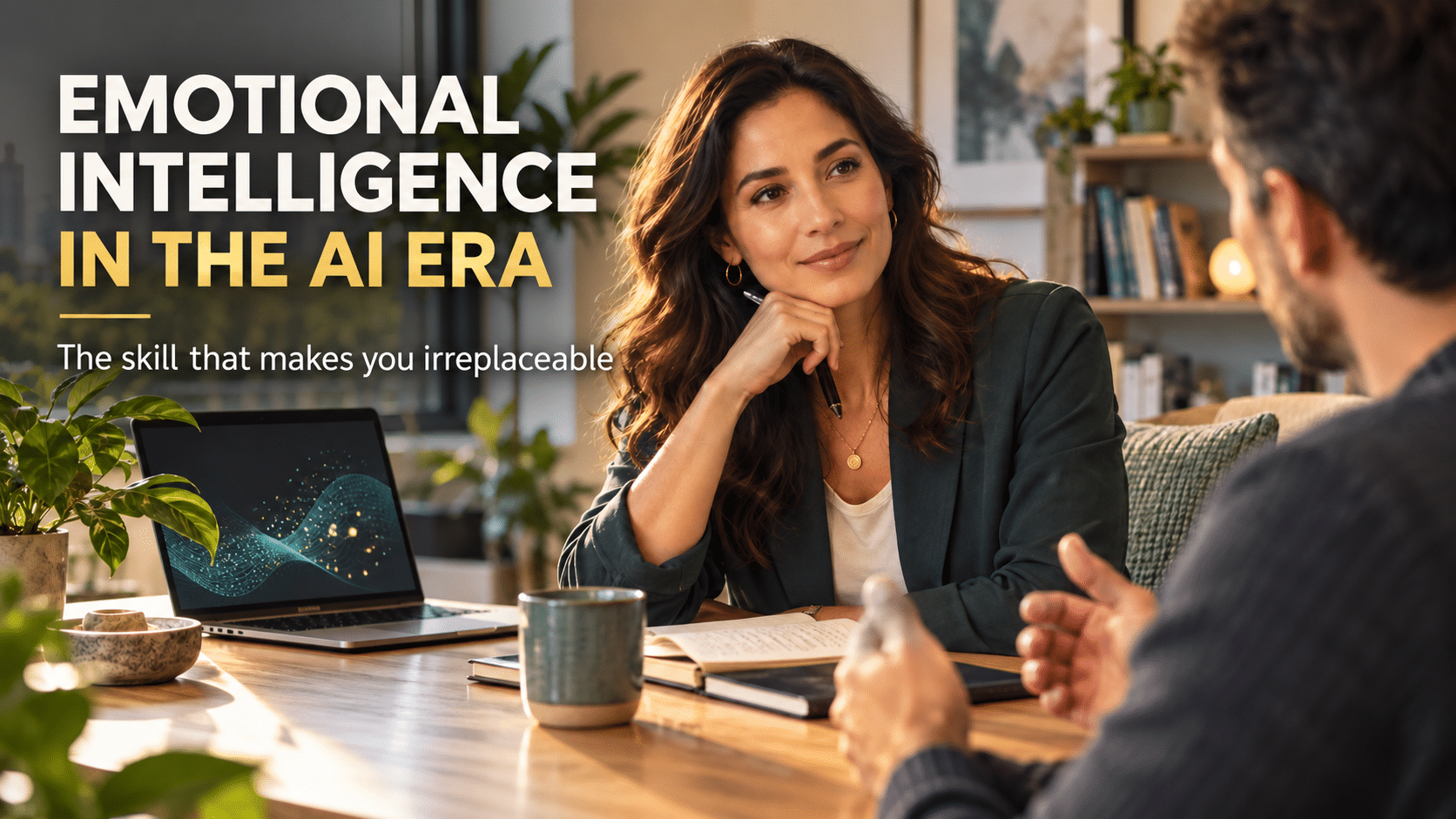
Emotional intelligence is becoming one of the most valuable human skills in the AI era.
Technology can now write, calculate, summarize, automate, design, predict, and analyze faster than most people imagined a few years ago. Because of this, many professionals and founders are asking a serious question:
"What will still make me valuable when AI can do so much?"
The answer is not only technical knowledge.
It is emotional intelligence.
In a world where machines can process information, humans still need to understand emotions, build trust, communicate clearly, handle pressure, and create meaningful connection.
That is where emotional intelligence becomes irreplaceable.
If you want to build deeper self-awareness and leadership capacity, the Coach For Life approach can help you grow from the inside out.
Emotional Intelligence Is a Human Advantage
Emotional intelligence is the ability to understand, manage, and express emotions wisely.
It also includes the ability to understand what others may be feeling and respond with maturity.
This does not mean becoming soft, passive, or overly emotional. In fact, emotional intelligence often makes people stronger.
It helps you pause before reacting.
It helps you listen before assuming.
It helps you speak honestly without hurting people unnecessarily.
It helps you lead without fear, ego, or constant control.
AI can give information. Emotional intelligence helps you use that information with wisdom.
Why Emotional Intelligence Matters More in the AI Era
AI is changing the value of work.
Many routine tasks are becoming easier to automate. Reports, drafts, data analysis, customer replies, research summaries, and basic planning can now be done faster with the right tools.
However, speed is not the same as wisdom.
A faster answer is not always the right answer.
A perfect script does not guarantee trust.
A smart recommendation does not automatically understand human fear, hesitation, resistance, or hope.
This is why emotional intelligence matters more in the AI era. The more technology handles tasks, the more human qualities stand out.
People will still need leaders who can calm uncertainty.
Teams will still need managers who can build trust.
Clients will still need professionals who can listen deeply.
Families will still need people who are present, patient, and emotionally available.
AI Can Support Work, But It Cannot Replace Presence
AI can help with productivity. It can reduce repetitive work. It can organize thoughts and speed up execution.
But it cannot truly be present with another human being.
It cannot sit with someone’s disappointment.
It cannot repair a relationship with genuine humility.
It cannot sense the full emotional weight behind silence.
It cannot replace the feeling of being understood by another person.
Human connection is not only about words. It is about attention, empathy, tone, timing, trust, and care.
That is why emotional intelligence remains powerful.
As AI becomes more common, people who can combine technology with emotional maturity will have a serious advantage.
Self-Awareness Is the Foundation
The first part of emotional intelligence is self-awareness.
Self-awareness means you can notice what is happening inside you before it controls your behaviour.
You can see when fear is driving a decision.
You can notice when ego is protecting an old wound.
You can admit when you are overwhelmed.
You can recognize when you are reacting to the past instead of responding to the present.
Without self-awareness, intelligence can become dangerous. A smart person without emotional awareness may still damage relationships, avoid feedback, blame others, or create stress around them.
In the AI era, self-awareness matters because people need to know what is human judgment and what is automated suggestion.
AI can offer options. But you must know yourself well enough to choose wisely.
Emotional Intelligence Builds Better Leadership
Leadership is not only about strategy. It is also about emotional climate.
A leader’s mood can shape a room.
A leader’s fear can create pressure.
A leader’s clarity can bring confidence.
A leader’s empathy can make people feel safe enough to speak honestly.
This is why emotional intelligence is essential for founders, managers, coaches, parents, and anyone who influences others.
Harvard Business Review has long emphasized that effective leadership depends on emotional intelligence, including self-awareness, self-regulation, motivation, empathy, and social skill. You can read more in HBR’s article on what makes a leader.
In simple terms, people do not only follow your plan. They also respond to your presence.
7 Emotional Intelligence Skills That Make You Irreplaceable
Emotional intelligence becomes practical when it shows up in daily behaviour.
Here are seven skills that matter deeply in the AI era:
- Self-awareness: knowing what you feel and why it matters.
- Self-regulation: staying steady instead of reacting impulsively.
- Empathy: understanding another person’s experience without making it about you.
- Active listening: hearing meaning, not just words.
- Emotional courage: having honest conversations instead of avoiding discomfort.
- Adaptability: staying open when change disrupts your plans.
- Relationship repair: taking responsibility when trust has been damaged.
These skills cannot be downloaded overnight. They are built through reflection, practice, feedback, and humility.
However, they can change everything.
Emotional Intelligence Improves Decision-Making
People often think emotions are the opposite of logic. But emotions are part of how human beings make decisions.
The problem is not emotion itself.
The problem is unmanaged emotion.
Fear may make you avoid opportunity.
Anger may make you speak too harshly.
Insecurity may make you chase approval.
Stress may make everything feel urgent.
Emotional intelligence helps you notice these inner signals without becoming ruled by them.
It gives you enough space to ask:
"Is this decision coming from clarity or fear?"
"Am I responding to the real situation or to an old pattern?"
"What matters most here?"
In the AI era, this matters even more. Tools may give you more data, but emotional intelligence helps you make better choices with that data.
The Future Needs Emotionally Strong People
The future will not belong only to people who know how to use AI.
It will belong to people who know how to stay human while using it.
The World Economic Forum’s Future of Jobs Report highlights the rising importance of human skills such as resilience, flexibility, leadership, social influence, empathy, and active listening. These are deeply connected to emotional intelligence. You can explore the skills outlook in the Future of Jobs Report.
This is an important sign.
As technology becomes more advanced, emotional maturity becomes more valuable.
The people who thrive will not be the ones who compete with machines at machine tasks. They will be the ones who use technology well while strengthening the human qualities machines cannot truly replace.
How to Build Emotional Intelligence
Emotional intelligence grows through practice.
Start by pausing before you react.
Name what you are feeling.
Ask yourself what your emotion is trying to protect.
Listen to understand, not only to reply.
Notice how your tone affects others.
Ask for feedback without defending yourself immediately.
Repair quickly when you make a mistake.
Spend time reflecting on repeated patterns in your relationships, decisions, and stress responses.
These steps may look small. But they create a different kind of strength.
Over time, emotional intelligence becomes the difference between being talented and being trusted.
Final Thought
AI will keep changing the world.
It will change how we work, learn, create, and solve problems.
But it will not remove the need for human connection, emotional courage, empathy, trust, and wisdom.
That is why emotional intelligence is not optional anymore.
It is a core skill for the future.
The more intelligent our tools become, the more emotionally intelligent we must become.
Because in the AI era, the most irreplaceable thing about you may not be how much you know.
It may be how deeply human you are.